
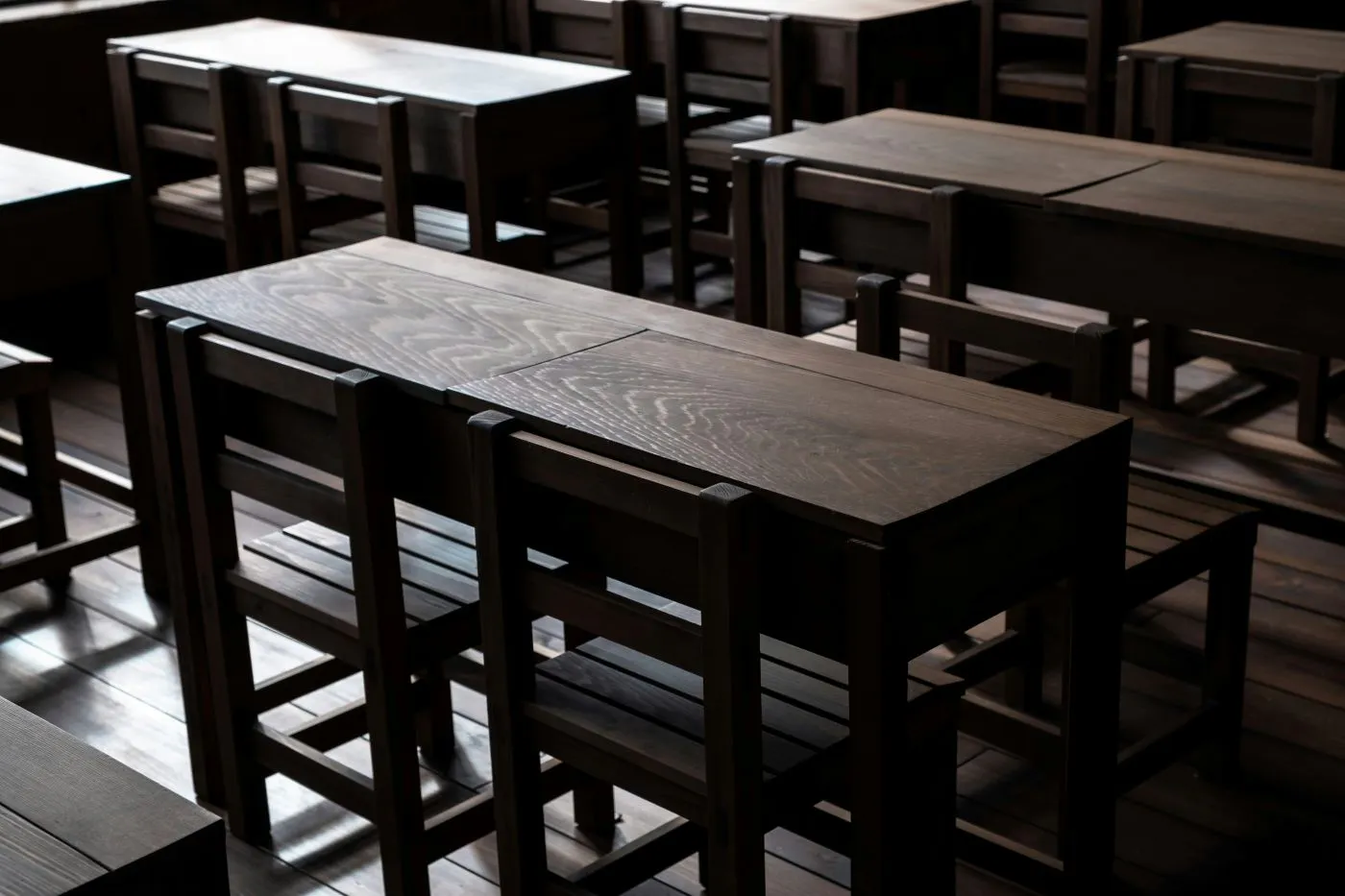
She kept climbing onto the desk and saying, “Au-dessus de.” Then she kept jumping down, standing beside it, and saying, “À côté de.” Again and again, until the difference finally landed in all of us.
And suddenly, this woman was standing on her desk, saying, “Au-dessus de.”
Then she jumped down, stood beside it, and said, “À côté de.”
That was the lesson. Or at least, that’s what the lesson became the moment Madame Healy decided the desk was no longer just a desk, but a piece of educational equipment with a supporting role in French grammar.
I remember sitting back in my chair, stunned by the sheer amount of effort she was willing to spend on a room full of students who did not yet know the French for “on top of” and “beside.” We were sitting there with our notebooks open, probably doing that particular student thing where you’re technically present but your soul is wandering the halls, and then, without much warning, our teacher climbed onto the furniture.
There are certain things you don’t expect adults to do in school. You expect them to write on boards, hand out papers, and you expect them to tell you to settle down, which is usually fair, even if nobody appreciates the accuracy of the observation at the time. You don’t expect them to stand on a desk and turn prepositions into a small athletic event.
But there she was.
She kept climbing onto the desk and saying, “Au-dessus de.” Then she kept jumping down, standing beside it, and saying, “À côté de.” Again and again, until the difference finally landed in all of us.
There was no elegant way to do this. You can’t really climb onto classroom furniture in front of teenagers and keep all your dignity tucked neatly into place. Desks aren’t stages. Fluorescent lighting isn’t kind. And yet there she was, turning herself into a living diagram because apparently the textbook had failed to bring the necessary theatrical commitment to French prepositions. And the strange thing is, it worked.
Of course it worked. How could it not? Once you’ve seen your French teacher standing above the desk, then beside the desk, the language stops being abstract. It stops being a pair of phrases floating around in the stale classroom air, waiting to be memorized long enough to survive a quiz. It becomes physical. It becomes ridiculous in the best possible way. It becomes something your brain can grab.
She didn’t have to do it. That’s the thing I still think about. She could’ve written the words on the board. She could’ve pointed to the book. She could’ve said them slowly, maybe underlined them twice, then given us an exercise on page whatever and called it a day. Instead, she climbed the desk.

She Didn’t Have to Do That
That’s the part I keep coming back to. Madame Healy didn’t have to do any of that.
She didn’t have to climb onto a desk in front of a room full of students who were not, I’m guessing, the most naturally generous audience in the world. Students are wonderful in theory, but in the wild, they can be a little rough on adults who appear to be doing something unusual. There’s always a chance the room turns on you. There’s always a chance someone decides this is the moment they become a critic, which is a terrible thing to discover halfway between the floor and a desktop.
She could’ve stayed safely at the front of the room and taught the lesson like a normal person with a functioning sense of self-preservation. She could’ve written the words on the board, drawn a little picture, pointed at the textbook, maybe used the desk with one hand in a respectable way. Nobody would’ve complained. Nobody would’ve gone home and said, “You know, I’m concerned Madame Healy didn’t physically embody the prepositions today.”
That’s what makes the moment matter to me now. It wasn’t required. It wasn’t some official teaching method she had to demonstrate before a visiting administrator. I don’t remember anyone standing in the back of the room with a clipboard, checking a box marked “teacher will risk mild bodily harm for vocabulary retention.” She just saw that the lesson needed something more, so she gave it something more.
There’s a difference between doing the job correctly and doing the job generously. Correctly would’ve been enough, at least on paper. The words would’ve been introduced. The definitions would’ve been clear. The curriculum would’ve moved forward in its little sensible shoes. If someone had walked in at the end and asked whether she had covered the material, the answer would’ve been yes. But covering material and teaching it aren’t always the same thing.
Covering material is often what happens when everyone agrees to pretend that exposure equals understanding. The words were said, the page was assigned, the lesson was delivered, and now the responsibility quietly slides across the room to the students. Whether it stuck is a separate problem. Whether it made sense is, apparently, something we can all discuss after the quiz has done its damage.
Madame Healy didn’t settle for that. She knew we weren’t quite getting it. Or maybe she knew we’d get it faster if the words had a body attached to them. So she gave the lesson a body. She made “au-dessus de” something we could see, and “à côté de” something that moved from one place to another right in front of us.
At the time, I mostly remember being amazed that a grown woman had decided the desk was now part of the curriculum. That felt like the headline. French Teacher Climbs Desk, Students Briefly Rejoin Life. But looking back, I see something else. I see a teacher making a choice.
Not a huge choice, maybe. Not the kind that gets a plaque, a district newsletter, or whatever ceremonial nonsense schools use when they want to honor someone without giving them more money. Just a choice to spend a little more of herself so the lesson would land.
That kind of thing is easy to miss when you’re young. You don’t always recognize effort when it’s being spent on you. You think adults are just doing adult things. You think teachers are just teaching because that’s what teachers do, the way clocks tick, and cafeteria milk arrives in tiny cartons that somehow make everything taste colder than necessary.
One night, walking home from play rehearsal, I saw Madame Healy and her husband walking toward their house, which was around the corner from where I lived. She was carrying a pizza.
That was it. Just a woman and her husband, walking home with dinner.
But to me, she wasn’t just a woman carrying a pizza. She was Madame Healy. She was the teacher who had climbed onto a desk and turned French grammar into something I could understand. In my head, she belonged to the classroom, to the chalkboard, to the strange little world where teachers seemed to exist only for the purpose of knowing things and making you know them too. And there she was, off duty, in the regular world, carrying a pizza like a person.
That’s one of the oddest things about being young. You don’t always understand that teachers have whole lives outside the classroom. Houses. Husbands. Dinners. Bad moods. Favorite shows. The need to get pizza home before it stops being the right kind of hot. They seem permanent and official, like fixtures installed by the school district.
But Madame Healy wasn’t a fixture. She was a person. A person who had a house around the corner, a husband beside her, a pizza in her hands, and somewhere inside her, the willingness to climb a desk so a room full of students would finally understand the difference between “above” and “beside.”
She had a choice. She could’ve kept both feet on the floor, and nobody would’ve accused her of failing us. Instead, she chose the desk, the jump, the repeat performance, the tiny loss of dignity that made the lesson impossible to forget.

Teaching Is the Extra Reach
Teaching gets talked about in big, official language. Standards. Outcomes. Curriculum. Assessment. The kind of words that sound like they were grown in a conference room under very little natural light.
And yes, all of that matters. You need structure, knowledge, and some kind of plan, otherwise a classroom becomes thirty people slowly realizing no adult is in charge.
But the part we remember usually isn’t the official part. It’s the extra reach. It’s the moment a teacher realizes the explanation isn’t landing, so they try something else. Not because the checklist asked for it. Not because there’s a bonus waiting somewhere in a mysterious envelope marked “excellent use of furniture.” They do it because the room needs another way in. That’s what Madame Healy gave us. Another way in.
The words by themselves were just words. “Au-dessus de” and “à côté de” could’ve stayed floating up there in the strange fog where new language lives before your brain decides whether to keep it. You can hear a word ten times and still feel like it’s tapping on the window from outside. You recognize it. You know it’s there. But it hasn’t come in yet. Then she climbed the desk, and the fog cleared.
The words had height. They had placement. They had a little danger in them, or at least the mild danger of a teacher putting both feet where, traditionally, notebooks and elbows had been. “Au-dessus de” became above. Not as a definition, but as a fact happening right in front of us. “À côté de” became beside because she was standing beside the desk, looking at us as if the whole mystery had now been solved, and honestly, it had.
That’s teaching. Or at least that’s the part of teaching no curriculum can fully contain. It’s the willingness to become the bridge between what you know and what someone else still can’t quite see. A curriculum can tell you what to cover. It can tell you what comes next, what pages matter, and what skills must be measured before the semester releases everyone back into the wild. But it can’t tell you how to make a room understand. That part belongs to the teacher.
It belongs to the person standing there, feeling the difference between polite attention and actual comprehension. It belongs to the person who can sense that the lesson has technically been delivered but not actually received. That’s a strange little difference, and if you’ve ever tried to explain anything to another human being, you know how real it is. You can say the right thing clearly and still watch it fall about six inches short of where it needed to land. So you try again.
Sometimes trying again means changing the words. Sometimes it means drawing something strange on the board that was meant to be a diagram but ends up looking like a crime scene map. Sometimes it means finding an example from some ordinary corner of life because the textbook example has all the warmth of a tax form. And sometimes, if you’re Madame Healy, it means climbing onto a desk and trusting that the lesson, the furniture, and your knees are all going to cooperate.
The generous teacher does more than deliver information. They notice. That’s the part. They notice confusion before it becomes embarrassment. They notice the room going quiet in the wrong way. They notice when students are nodding, not because they understand, but because nodding is the universal teenage signal for “please don’t call on me.”
And then they make an adjustment. Not a grand one necessarily. Not always a desk-climbing adjustment. But something. A shift in tone. A different example. A willingness to look a little foolish for a minute so someone else can feel less lost.
That’s the extra reach. It’s not in the credentials. It’s not in the curriculum. It’s not the part of teaching that fits neatly into a form. It’s the human part, the improvisational part, the part where a teacher looks at the lesson, looks at the students, and decides the shortest distance between confusion and understanding might involve standing on the furniture.
The Teachers We Remember
Most of us have had a teacher like Madame Healy at some point. Maybe not one who climbed furniture in the name of grammar, because even in education, there are limits, and also insurance concerns. But someone who found the strange door into the lesson and opened it.
That’s usually what stays with us. Not the worksheet or the quiz or the chapter title printed at the top of the page as if anyone ever loved a chapter title. We remember the teacher who noticed the room drifting and changed course. The one who made the idea less flat. The one who cared enough to try again in a different way.
And it doesn’t always look dramatic. Sometimes it’s just a sentence that makes the whole thing click. Sometimes it’s an example so oddly specific you can still hear it years later. Sometimes it’s a teacher refusing to let confusion sit there like a damp towel in the middle of the room.
There’s a real kindness in that. Not the soft, greeting-card version of kindness, where everything smells faintly of lavender, and nobody has a complicated feeling. The useful kind. The kind that pays attention. The kind that notices when someone isn’t getting it and doesn’t mistake silence for understanding.
That kind of teacher changes the temperature of a room. They make it safer not to know yet, which is one of the most underrated gifts in any classroom. Because not knowing can be embarrassing when you’re young. It can feel like everyone else received instructions before you arrived, and you’re the only one still standing there trying to find the door.
A good teacher doesn’t shame that. They work with it. They know confusion isn’t a character flaw. It’s just the place where learning starts, which sounds obvious now, but in school, it didn’t always feel that way. There were plenty of moments when the goal seemed to be looking like you already understood, even when you absolutely did not.
That’s why the teachers who stay with us are often the ones who make understanding feel possible instead of humiliating. They didn’t just deliver the material. They read the room. They felt where the energy dropped, where the eyes glazed over, where the silence meant nobody understood, but everyone was hoping someone else would admit it first.
Then they adjusted. They reached past the plan. They made a small human offering to the lesson.
That’s why we remember them. Not because they performed. Because they cared enough to make the lesson land.
The Takeaway
I still know what “au-dessus de” means.
That’s a little ridiculous when you think about it. I’ve forgotten whole stretches of school. Entire units are gone. Names, dates, formulas, quizzes I probably panicked over at the time have all wandered off into whatever storage closet the brain uses for things it no longer feels emotionally responsible for. But I remember Madame Healy on that desk.
I remember her saying the words from above us, then jumping down beside the desk and saying the other words. I remember the room understanding because she made it impossible not to. She didn’t just explain the difference. She staged it. She climbed into its meaning, which sounds dramatic, but only because it was. In the odd little theater of that classroom, a French preposition got blocking.
That’s the thing about real teaching. It leaves a mark because it costs the teacher something. Not always a lot. Sometimes just a little dignity, a little energy, a little extra invention at the exact moment when easier would’ve been perfectly acceptable.
And that’s not only true in a classroom. It’s true in communication, in branding, in any moment where one person is trying to help another person understand something. At ThoughtLab, we talk a lot about making ideas land, because that’s usually where the real work is. Not in having the idea. Not in saying the idea. In finding the form that helps someone actually receive it. Madame Healy found the form. It happened to be a desk.
She could’ve stayed on the ground. She could’ve kept the lesson neat, normal, and safe. She could’ve said the words slowly, maybe underlined them twice, then given us an exercise on page whatever and called it a day. Instead, she climbed the desk, and decades later, I still know the difference.